Wednesday, July 18, 2007

Experiment Running Decimates Blogging

Interesting statistic of the day: There is a strong inverse correlation between hours devoted to preparing and launching an experiment and frequency of Weblog posting.

Labels: , ,

Thursday, April 05, 2007

Semester's Third Experiment Finally Running

Well, participant number 2 is running as we speak.

Ugh. Thank goodness for a three-day weekend. I am beat.

Labels: ,

Wednesday, April 04, 2007

Experiment Prep Puts Life on Hold


This is a screen capture from the episode of ER used in the current experiment. It is part of the signal detection recognition memory test.


This is my life right now. Insanity. Trying to fit 28 hours into 24 hour days.

Come on, mid-May. I know you'r e just around the corner.

Labels: ,

Thursday, March 08, 2007

Political Orientation Affects Perceptions for All


Recently, my lab has been investigating the cognitive processes underlying the cultivation effect.
In a nutshell, this effect shows that people who watch a lot of television give higher estimates of crime prevalence (among other things).
One of the qualifiers of the cultivation effect is so-called mainstreaming.
That is, the television portrayal of the social world tends to most strongly affect social perceptions of those with views far from the mainstream. In this line, heavy TV viewing has been shown to bring them into the mainstream.
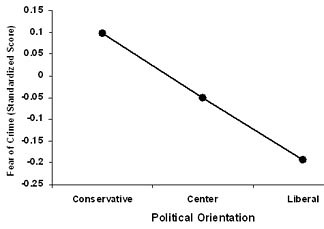
In this figure that I presented at our brown bag luncheon yesterday, we see little evidence of mainstreaming on crime perceptions. Instead, after statistically controlling for age, sex, income, GPA, and need for cognition, we see little effect of TV across the three political orientations. Nonetheless, the strong main effect of political orientation persists.

Labels: , , ,

Tuesday, February 27, 2007

Fingers Crossed: Physiology Data Rolling

Things were looking good about two and a half hours ago. Data were rolling in. The very first psychophysiological experiment was running in the college of mass communications at Texas Tech University.

It gets pretty boring watching what the participants are watching, so I decided to fire up the laptop and write a post similar to this.

But then Murphy's Law -- or as I like to call it, Sam's Law -- kicked in.

Literally as I was typing my Blogger.com login, the stimulus computer crashed.

It's still crash-friendly, and I cannot figure out why. Arrrrgh. Thanks, MediaLab!

The second participant is running, and hopefully I will actually be able to use her/his data.

My fingers are crossed. Luckily the SNAFU happened to me, as all of the graduate students are in class.

Labels: , ,

Saturday, February 24, 2007

Indiana, Texas Tech Student Politics

Yesterday I wrote about how I believe the political orientation of my subject pool may be affecting our studies on social reality perception. I wanted to provide a visual aid to demonstrate this.

I borrowed this measure of political orientation from Indiana University professor Erik Bucy, Ph.D. In addition to the measure, he sent me a pie chart with political orientation frequencies taken at IU this spring (2007).

Keep in mind that Indiana is a red state through-and-through, although IU is the more liberal of the major state universities (Purdue students tend to be more conservative).


Indiana University Students 2007


Texas Tech University Students 2007


These pie charts support my contention that Texas Tech students in 2007 are far different than Rutgers (the state university of New Jersey) students in the the late 1990s in terms of political orientation.


Labels: , , , ,

Friday, February 23, 2007

Political Orientation Predicts Crime Estimates

There were 266 murders in New York City during 2006, according to the FBI.

We asked Texas Tech students to estimate how many murders there are on the NYC subways each year. The median number was 56. However, more than 8% of our participants estimated more than one murder per day on the subways alone.

What makes some people think that crime is so prevalent? And how does that happen in the brain?

The data are in for my most recent foray into the world of social reality. And I must admit that I am fascinated.

Last fall we ran a study to try to answer this question.

We have known for a long time that television viewing correlates with fear of crime. The more people view, the more fearful they are.

Shrum (2001) showed that if you tell people to try hard when making decisions about crime, then the relationship between TV and crime estimates drops out.

We thought that we could extend that by illustrating the role of a good memory.

But the data did not work. I had some vague idea why the study might have failed, but I was not sure. The thing that kept jumping out at me was that the original study was performed at Rutgers (a blue state), and we're here in West Texas (red-ville).

So we tried a more complete replication of the original study, and I tacked on some political and religious leaning questions at the end. They were the very last questions on the questionnaire so that they could not affect other answers.

Once again we have failed to replicate the original study. But now I just might know why. Political leaning appears to play a prominent role in estimating crime. Our data show that for conservatives, it is a mean world.


Recall that these new experiments were trying to explain why telling people to be "accurate" negated the effects to TV viewing. That is, when people in New Jersey were told to be accurate, they gave lower estimates of crime.

But accurate is relative. Just how likely is a crime if you walk through a New York City park every night for a month? There is some probability tied to this, but we could not likely every know it.

So, if you have a lot of fear, then what do you do when you are told to try really hard to be accurate?

You become more afraid.
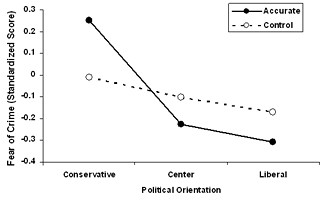


For conservatives, the accurate world is a world with more crime. For liberals, the accurate world is a world with less crime.

Replicating Shrum's data depended on accurate becoming less crime-filled for those who watched a lot of TV. This simply did not happen for our conservative West Texas students.

The New Jersey sample surely had a minority of conservatives. These data are for 86 students who identified themselves as "strong conservative" or "conservative," 75 students who identified themselves as "center," and just 41 who identified themselves as "liberal" or "strong liberal."

These data add an interesting new piece to the puzzle.

I cannot, as a scientist, help but ponder the relationship to the current debate surrounding the war in Iraq. If the world is meaner to you, then Iraq represents a bigger threat. Admittedly this is speculative, but interesting to ponder.

Labels: , , , ,

Thursday, February 22, 2007

Experiments Seem to Control Me

One of the primary advantages of experimental design, I told my undergraduate research methods class yesterday, is control. We can control almost everything (as in hold the same, not in the authoritarian kind of way).

The problem for the scientist, then, is that you have to control everything. I am in the midst of a two-week run to get two experiments ready to go. The details are tedious, unending, and not of interest to anyone but me.

The project is all consuming, so I have been unable to muster anything remotely interesting to say here. When the experiments are done, however, there should be many interesting things to say.

Until then, my life is a blur of Adobe Audition, MediaLab, and Macromedia (Adobe) Dreamweaver.

Labels: , ,

Monday, February 12, 2007

Sequential MPEGs Lead to Flashing Woes

Update: This single line of code makes the flash much briefer!

jP.setBackground(Color.black);


A small copper wire comes in the back of my house. Through that small, little copper wire comes myriad cable television channels, digital cable (and dozens of channels of digital music), broadband Internet, and my landline (which we never use and need to get rid of).

That's an amazing damned wire. One stupid wire.

This week I am trying to get an experiment ready to run. For that experiment, I need to show multiple video clips in a sequence. They're chopped up in a particular order for very particular reasons.

I would like for those clips to go together seamlessly. However, this seems impossible. The MediaLab software we use goes to a blank screen between clips, which results in a flash between clips.

I hate this flash. I have spent days trying to get rid of this flash. Finally I resorted to programming myself in Java. I spent much of the day today trying to get the code right. I'm a hack as a programmer, so I have to beg, borrow, and steal code.

Finally, at 8:30 p.m. tonight, after my kids went to bed, I got two clips to play back-to-back in Java.

And guess what?

Flash! That's what!

My laptop is new and pretty darned fast. Millions or billions of calculations per second.

Showing two MPEG clips back-to-back without a flash? Priceless, apparently.

Lest you think that I'm simply being obsessive about the flash (admittedly probable), there is a scientific reason that I hate the flash.

We study the orienting reflex, a preattentive reflex in response to novelty in the environment. Something so simple as a scene change in a television program reliable elicits an orienting reflex (see the work of Annie Lang).

So I know that a huge flash between clips will sure as heck elicit an OR.

And since I am studying cardiac response, I would strongly prefer not to artificially elicit a massive OR.

One little cable can carry as much information at the Library of Congress, but playing two clips in serial eludes modern computation.

Go figure!

Labels: , ,

Tuesday, January 30, 2007

Social Reality Data Collection Resumes

How does your brain decide how dangerous the world is?

What role does television play in that decision making?

These are questions I have been trying to answer since Fall 2001. The quest began anew Monday, as we started collecting data on a pen-and-paper replication and extension of past work.

A computer-based replication last fall presented us with entirely unexpected results. Now we simplify and try again.

Labels: , ,