Tuesday, February 05, 2008

Thanks for the Memories, General

Coach Knight, you will be missed.

Labels: , , ,

Saturday, October 13, 2007

Scenes from Indiana: Hoosier Hysteria

Photo copyright 2007 by the Indianapolis Star.

Ah, I miss those 5 championship banners in Assembly Hall.

Labels: , ,

Saturday, June 23, 2007

Looking Back on 2 Years with a Ph.D.

Two years ago this week, I defended my doctoral dissertation in telecommunications (technically mass communications) and cognitive science at Indiana University.

As with so many things in the past, this "two year" figure is mind-blowing for the fact that it both seems far more than and far less than two years ago.

So much has happened since then. We moved to Columbus, Ohio, and spent a year at The Ohio State University. Then for reasons that are largely family oriented, we moved to Lubbock, Texas, where I spent the past year at Texas Tech University.

I built a psychophysiology lab at both places, and I trained graduate students to work in each place. In so many ways, that must have taken more than two years.

At the same time, June 2005 could be yesterday. I can remember holing away at the education library at Indiana to proofread yet one more draft of the dissertation before handing it over to my advisor, Annie Lang.

All this time my kids are two years older and my hair is two years, well, less dark brown.

Two years. Seven hundred and thirty days.

One third of the "tenure track" has passed by. We accomplished a lot, but we could have done more. That's how I always feel. There's always the one additional data set that we did not get collected or the one additional manuscript that we did not get out the door.

We'll keep trying. I'll keep you posted on the progress. In a week or so, this interminable summer class will be finished, and the research will begin in earnest. Look for some cool figures here in the near future.

Labels: ,

Sunday, March 11, 2007

NCAA Tourney Provides Highs, Lows


Media dependency is in full force here, as I spent the evening glued to the television watching the NCAA and NIT selection shows.

Last night I was celebrating that my New Mexico State Aggies (B.A., 1997) won the Western Athletic Conference tournament and an automatic bid to the NCAA tournament.

Tonight I am mourning that my Kansas State Wildcats (M.S., 2001) are snubbed and headed to the NIT. The Cats are the first team in the history of the 64-team field from a power conference that won 20 games, won 10 conference games, and finished in the top 4 of the conference and not make it to the Big Dance.

The Indiana Hoosiers (Ph.D., 2005) have a difficult draw, playing Gonzaga in Sacramento.

The Texas Tech Red Raiders (current employer) are also in, and Bob Knight will have his hands full with Boston College.

Let's hope coach Bill Self and the Kansas Jayhawks (childhood favorite) will finally win in the first round. Since the name of their opponent does not begin with the letter "B," odds are good.

Finally, the Ohio State Buckeyes (former employer) receive the almost automatic bid to the round of 32, as no No. 1 seed has ever lost to a No. 16 seed.

Let the games begin.

Labels: , , , , ,

Saturday, February 24, 2007

Indiana, Texas Tech Student Politics

Yesterday I wrote about how I believe the political orientation of my subject pool may be affecting our studies on social reality perception. I wanted to provide a visual aid to demonstrate this.

I borrowed this measure of political orientation from Indiana University professor Erik Bucy, Ph.D. In addition to the measure, he sent me a pie chart with political orientation frequencies taken at IU this spring (2007).

Keep in mind that Indiana is a red state through-and-through, although IU is the more liberal of the major state universities (Purdue students tend to be more conservative).


Indiana University Students 2007


Texas Tech University Students 2007


These pie charts support my contention that Texas Tech students in 2007 are far different than Rutgers (the state university of New Jersey) students in the the late 1990s in terms of political orientation.


Labels: , , , ,

Monday, January 15, 2007

Mean World: Local TV No. 1 News Source

It is often said that if you typed up the entire script for a 30 minute television newscast, it would equal fewer than two pages of a daily newspaper.

This, in part, is why I am a print guy. I read the Avalanche-Journal almost every day. In contrast, I watch local TV news less than once a week (in some irony, it is on now).

Recent data suggests that I am alone. The Gallup Poll reports that, "Local TV Is No. 1 Source of News for Americans" (I believe this link will become pay only in a few weeks).

According to self-report data, 55% of Americans get their news from local TV news every day, whereas only 44% get news from local newspapers every day. Nightly network news is third with 35% of Americans.

There are so many interesting issues inherent in these data. Foremost is the weak link between TV news exposure and learning from the news. Some studies have even found a negative correlation between TV news exposure and current events knowledge (for example, see work by my former Ohio State colleague Gerald Kosicki).

Inseparable from this is the linkage between media usage and socio-economic status. In general, "elites" use print media, whereas those with lower incomes tend to get their news from television.

I get most of my news from the Internet (although most often the Web sites of print newspapers). Only 22% of my fellow Americans get news from the Internet every day, another connection with socio-economic status (the so-called digital divide).

The dominance of TV news is troubling for multiple reasons. First, there is my own bias (yeah, print!). More concerning is the brevity with which news items must be covered on television. There's no time to talk about a story for five minutes.

Covering issues with brevity makes issues especially susceptible to how they are presented (for example, framing). It logically follows that if I get only a few sentences about a given issues, then those sentences will be especially influential in my thinking about that issue.
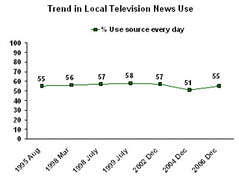


Interestingly, this trend is static over time (see above chart courtesy of Gallup).

I was involved with studies examining the cognitive processing of local TV news while at Indiana University. In one study (Lang et al., 2005) , we found that faster pacing (i.e., more frequent camera changes) increased evaluations ... especially among younger viewers (you can find a link to this channel changing research study here).

Perhaps most helpful to local news producers are Annie Lang et al.'s "7 rules" for making news memorable without sacrificing factors that influence positive evaluations (Lang, Potter, & Grabe, 2003).

No matter how memorable local news can be, it's still not your daily paper. As a society, there is some cause for concern that the majority of Americans learn about the world from local newscasters.


References

Lang, A., Potter, D., & Grabe, M. E. (2003). Making news memorable: Applying theory to the production of local television news. Journal of Broadcasting & Electronic Media, 47, 113-123.

Lang, A., Shin, M., Bradley, S. D., Lee, S., Wang, Z, & Potter, D. (2005). Wait! Don't turn that dial! More excitement to come! The effects of story length and production pacing in local television news on channel changing behavior and information processing in a free-choice environment. Journal of Broadcasting & Electronic Media, 49, 3-22.

Labels: , , ,