Tuesday, September 16, 2008

Turn Radio Off for That Sweet Sound

It may seem silly, but perhaps the best decision I have made of late is to drive to and from work with the radio off. Just silence. Me and my thoughts.

My Missouri colleague Paul Bolls did an entire media fast. I could not make it for a week. But having 20-30 minutes a day of silence is surprisingly refreshing.

It was very difficult at first. I can drive to work in under 15 minutes, and I must have automatically turned the radio on four or five times every trip.

It's nothing against the radio. It's just some small fight against the urge to be (media) stimulated every moment of every day. I think our brains have way too much background noise.

A little silence is golden.

My apologies to the Audio Prof.

Labels: , ,

Monday, March 10, 2008

Child's Untimely Death May Be Media Effect

From Seattle's KING TV:
Everett boy buried in sandbox dies

07:00 PM PDT on Monday, March 10, 2008

By DEBORAH FELDMAN / KING 5 News and KING5.com Staff

EVERETT, Wash. - An Everett-area family is in mourning after a 10-year-old boy died after being buried alive by his playmates.

In a statement, the family of Codey Porter says he died peacefully at 3:35 p.m. with his family by his side.

The bizarre incident, which happened on Saturday, may have been sparked by a television cartoon.

Family members describe Codey, a fifth grader at Silver Firs Elementary School in Everett, as smart and imaginative. Unfortunately, it may have been his imagination that led to his critical situation.

"Really articulate. He's got a really good imagination too. He's just not a regular 10-year-old," said Joshua Quantrille, 30, who is Codey's half-brother.

Quantrille said Codey was playing with his own three sons and several other children Saturday in the backyard of a family friend's home.

"They watch a cartoon where there were like sandmasters or something. They can manipulate sand or something like that," said Quantrille. "He came up with an idea if he were to do this, then he would be able to be one of them. They're all under 10, so a pretty crazy imagination, you know. They were like hey, OK."

The cartoon "Narutu" shows the characters using sand as a tool and weapon and could have been what Codey and the others were trying to mimic when he was buried, headfirst, in a sandbox in the backyard of the house.

Labels:

Sunday, March 11, 2007

NCAA Tourney Provides Highs, Lows


Media dependency is in full force here, as I spent the evening glued to the television watching the NCAA and NIT selection shows.

Last night I was celebrating that my New Mexico State Aggies (B.A., 1997) won the Western Athletic Conference tournament and an automatic bid to the NCAA tournament.

Tonight I am mourning that my Kansas State Wildcats (M.S., 2001) are snubbed and headed to the NIT. The Cats are the first team in the history of the 64-team field from a power conference that won 20 games, won 10 conference games, and finished in the top 4 of the conference and not make it to the Big Dance.

The Indiana Hoosiers (Ph.D., 2005) have a difficult draw, playing Gonzaga in Sacramento.

The Texas Tech Red Raiders (current employer) are also in, and Bob Knight will have his hands full with Boston College.

Let's hope coach Bill Self and the Kansas Jayhawks (childhood favorite) will finally win in the first round. Since the name of their opponent does not begin with the letter "B," odds are good.

Finally, the Ohio State Buckeyes (former employer) receive the almost automatic bid to the round of 32, as no No. 1 seed has ever lost to a No. 16 seed.

Let the games begin.

Labels: , , , , ,

Saturday, March 03, 2007

Tech Changes Fast; Teach Thinking Instead

I'm not sure what to write. I'm not sure what I even think right now. It's still digesting.

Yesterday, the college of mass communications' national board of directors met in Lubbock.

I was born in the Midwest, and I have spent most of my life living in the "middle." One of the problems with living in the middle is that the population centers are on the coasts. And it's difficult to get people to come to the middle.

That's what makes yesterday's meeting so amazing to me. Sitting in Lubbock, Texas, (not quite the backwater of its image but not exactly Times Square), we had a room full of heads of media industries. I won't waste time dropping names here, but there were an impressive array of leaders from all areas of media.

It is likely that had I not come to Tech, I would never have been in the company of so many decision makers at one time. And we were in Lubbock, not New York City.

It was a fascinating round table discussion. We listened as they talked about what today's students need. The recurring theme was the change of pace of new technology.

We cannot teach that, of course. By its very definition, fast-paced change is, well, changing too fast to teach. If you've never taught a college course, you may not know how much time goes into getting the course ready. Even if you take a semester to get a course prepared on, let's say, user-created ads (such as those in the Super Bowl), by the time the students show up for the course, you might as well be teaching the telegraph.

Things will have changed.

As I sat there, I kept thinking that this fast pacing means that we must focus on creative thinking more than even. Instead of trying to keep up -- for example my first journalism class at NMSU was the last semester they actually used typewriters -- we need to take a step back from technology and teach thinking.

I sat pondering this, and then my colleague Coy Callison actually said it out loud. Thanks, Coy. Of all of those media leaders, none likely even heard the word Internet in a college classroom. Yet they manage to lead large corporations in a digital era.

Along the way, someone taught them to think. And that has served them well. And I think that is our job in the university classroom today.

Don't get me wrong. I will make changes in the way I teach because of what I heard on Friday. I will make changes as soon as Monday. But I will not throw my syllabus in the wastebin because the media industry is changing fast.

In an address Thursday night, board member David Fowler, a creative guru at Ogilvy & Mather, talked about the "big idea." He was referring to David Ogilvy's quotation, "It takes a big idea to attract the attention of consumers and get them to buy your product. Unless your advertising contains a big idea, it will pass like a ship in the night."

Today the big idea is more important than ever.

I will not concede to Marshall Mcluhan. Not today. Not ever. The medium is not the message. The message is still the message. And you still need the big idea ... perhaps more now than ever. And our students are far better served learning how to come up with the idea than chasing the current media fad.

Labels: , , ,

Thursday, February 08, 2007

Toddler Story Packs Powerfully Sad Media Effect

Today we finish data collection for a study investigating (the cognitive processes behind) how television colors your perception of social reality. I say this to illustrate that I study how the media make you think it is a "mean world," to use a term popular in the literature.

I just finished reading an absolutely horrific story on CNN.com. I'd link directly to the story, but that would mean I would have to go back and look at the page.

And I cannot.

The summary is that Pittsburgh police allege that a man left his 2-year-old toddler outside to die in the cold.

That's extremely sad.

But then I read the next part. The part about little footprints around the body, suggesting the toddler got up and wandered a bit before succumbing to the cold.

And then I lost it. I couldn't even look at the page.

If you don't have kids, you won't really get it. But if you have kids, you will understand how a story such as this reaches right into the core of your being and shakes something primeval. A whole new chamber opens in your heart when you have kids, so to speak.

I was raised a male in America, so I can pretty much witness any atrocity and not shed a tear. It's an adaptive thing, really. But if you start telling me a story about someone hurting kids -- and that almost always comes from the media -- I cannot take it. It's the worst kind of torture. You cannot hear that and not think of your own children.

The funny thing, to me, is that my knee-jerk reflex to this story is to want to go get my kids out of school and hug them. Because it's a sick *$&#ing world. And for that moment, I just want to know that they're safe.

Percentage-wise, it's a pretty safe world. But the fact that even one person might have specifically tried to freeze their kid makes for a pretty twisted world.

Sure, my kids have driven me to the brink of insanity. They can push every button that I have. But I cannot imagine ever wanting to seriously hurt any of them even for a moment.

Emotion drove me to click on the link to that story, and stronger emotion drove me to click away from it. That's why I study media psychology. But I sure wish I hadn't read that story.

Labels: , , , ,

Sunday, February 04, 2007

Watching Super Bowl Ads 'On Duty'


I watched the Super Bowl as an ad critic today. On Friday, a reporter from the Lubbock Avalanche-Journal called and asked whether I would watch and give them a top 3, worst 3, and overall remarks. After getting over the shame of being their second choice, I agreed.

So I logged every ad. I paid attention to which ads made me laugh and which ads made my wife, Emily, laugh. She here are my Top 3 and Bottom 3.

Top 3
1. Bud Light: Rock, Paper, Scissors
2. Bud Light: Fist Bump
3. T Mobile: Charles Barkley as Dwayne Wade’s "dad"

Honorable Mention
CBS: David Letterman and Oprah

Bottom 3
1. Snickers: Two mechanics kissing
2. Sierra Mist Free: Beard comb over
3. Garmin Navigation: Maposaurus


Here are my concluding thoughts, which were primed by a great Super Bowl TV network post by my colleague Rob Potter:

CBS was another huge winner that will not occur to most people. I counted dozens of promotions for CBS shows, many of which already top the ratings. The promotional spot with David Letterman and Oprah in Colts and Bears jerseys was among my favorite spots of the night. CBS promos were everywhere. CBS came out of the halftime show promoting 5 straight CBS programs and specials.

Labels: , , , ,

Wednesday, January 17, 2007

Flank Right, Wee Man


"Flank right, Wee Man," are perhaps the most profound words uttered on television thanks to CBS's new reality show, Armed and Famous.

Muncie, Indiana, will never be the same.

Runner-up for the night was a drunk automobile passenger telling WWE star Trish Stratus, "You're a sexy bitch."

Culture at its highest, I tell you.

Labels: , ,

Monday, January 15, 2007

Mean World: Local TV No. 1 News Source

It is often said that if you typed up the entire script for a 30 minute television newscast, it would equal fewer than two pages of a daily newspaper.

This, in part, is why I am a print guy. I read the Avalanche-Journal almost every day. In contrast, I watch local TV news less than once a week (in some irony, it is on now).

Recent data suggests that I am alone. The Gallup Poll reports that, "Local TV Is No. 1 Source of News for Americans" (I believe this link will become pay only in a few weeks).

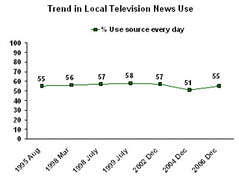
According to self-report data, 55% of Americans get their news from local TV news every day, whereas only 44% get news from local newspapers every day. Nightly network news is third with 35% of Americans.

There are so many interesting issues inherent in these data. Foremost is the weak link between TV news exposure and learning from the news. Some studies have even found a negative correlation between TV news exposure and current events knowledge (for example, see work by my former Ohio State colleague Gerald Kosicki).

Inseparable from this is the linkage between media usage and socio-economic status. In general, "elites" use print media, whereas those with lower incomes tend to get their news from television.

I get most of my news from the Internet (although most often the Web sites of print newspapers). Only 22% of my fellow Americans get news from the Internet every day, another connection with socio-economic status (the so-called digital divide).

The dominance of TV news is troubling for multiple reasons. First, there is my own bias (yeah, print!). More concerning is the brevity with which news items must be covered on television. There's no time to talk about a story for five minutes.

Covering issues with brevity makes issues especially susceptible to how they are presented (for example, framing). It logically follows that if I get only a few sentences about a given issues, then those sentences will be especially influential in my thinking about that issue.


Interestingly, this trend is static over time (see above chart courtesy of Gallup).

I was involved with studies examining the cognitive processing of local TV news while at Indiana University. In one study (Lang et al., 2005) , we found that faster pacing (i.e., more frequent camera changes) increased evaluations ... especially among younger viewers (you can find a link to this channel changing research study here).

Perhaps most helpful to local news producers are Annie Lang et al.'s "7 rules" for making news memorable without sacrificing factors that influence positive evaluations (Lang, Potter, & Grabe, 2003).

No matter how memorable local news can be, it's still not your daily paper. As a society, there is some cause for concern that the majority of Americans learn about the world from local newscasters.


References

Lang, A., Potter, D., & Grabe, M. E. (2003). Making news memorable: Applying theory to the production of local television news. Journal of Broadcasting & Electronic Media, 47, 113-123.

Lang, A., Shin, M., Bradley, S. D., Lee, S., Wang, Z, & Potter, D. (2005). Wait! Don't turn that dial! More excitement to come! The effects of story length and production pacing in local television news on channel changing behavior and information processing in a free-choice environment. Journal of Broadcasting & Electronic Media, 49, 3-22.

Labels: , , ,

Friday, January 12, 2007

Dropping Cingular Brand Still a Bad Idea

AT&T is making news this week for their still idiotic decision to abandon the Cingular brand. I criticized dropping Cingular when first announced, and I still think it is a bad move.

According to today's Detroit News, Cingular is the No. 1 cell provider in the nation. AT&T is old school. It is history. Most importantly, it is irrelevant to today's most prized demographics.

The land line is like the buggy whip. It's going away. They took the land lines out of Texas Tech dorms this year. Gone. No more.

AT&T's brand is not worth much to Gen Y, but Cingular is. Earlier, Advertising Age reported that $4 billion had been spent establishing the Cingular brand. That's billion with a "B."

This is an arrogant decision by a company run by a board of directors that I will bet is predominantly run by old white guys (yup, 11 out of 17 are old white guys; all look well beyond 40; and several look as if they were actually present when Alexander Graham Bell uttered the words, "Mr. Watson -- come here -- I want to see you.").

Memo to AT&T directors: the world has passed you by. To quote Eminem, "You're too old. Let go. It's over."

Cingular is the future. AT&T is the past. The students in my college class look at your technology much like I looked at two cans connected by a string.

So you're trashing $4 billion to revive a dying brand. Foolish.

Imagine someone buying the fledgling automobile company from Henry Ford, trashing the name and instead calling it the Summers' Buggy Company.

"No," you say.

Yes, sadly.

It's a bad move. To try to undo the $4 billion brand name, AT&T will be using both logos, the orange jack and the deathstar in coming months. They ever have some clever ads that will use themes from past Cingular ads.

In one clever ads, tractors that formed the "bars" image in previous ads will now form the deathstar logo. Albeit clever, it assumes a lot of memory on the part of viewers.

Verizon (No. 2 carrier) says they are not changing their strategy. If I were an existing cell phone brand, I would launch a full out assault. The brand switch will create confusion, and I would attempt to capitalize on that.

If it were me, I'd rename AT&T to Cingular. That's progress. That's future.

I'm not predicting that the behemoth will go under, but it's a huge waste of money. If I were a major stockholder, I would be furious.

Labels: , ,

Sunday, January 07, 2007

Do Not Rely on Media for U.S. Border Opinion

Some people believe that an alien spaceship crashed in the New Mexico desert in July 1947 (read more). Given the remote location and sparse population, few people have any firsthand experience. Therefore, almost all of our knowledge is mediated.

I thought about this while driving through Roswell on Saturday. When you drive through the heart of town, everything is tourism alien-themed. We went to the International UFO Museum and Research Center a few weeks back (read here). This leads to complicated questions from the children, such as "What do aliens do to you?"

My children must suffer through the academic answer. I tell them that we have very little evidence that any alien lifeform has ever visited Earth. I do, however, spare them the mathematical details about the vast number of planets in the universe that are similar enough to Earth to support life as we know it.

The point is that most people have an opinion about what happened at Roswell, even though none of us was there. We have learned through the media.

Let me use a more concrete example. No matter your political persuasion, you probably believe that President Bush actually exists. However, of the 6 billion people on this planent, perhaps 1 million have ever actually seen the man in person (including rallies). So as far as you know, there is no real person, and all of the TV coverage takes place on the sound stage next to the one where they faked the moon landing (kidding).

My point is that we lean pretty heavily on the media to shape our reality, even though we do not think that we do. This is true with the U.S. border with Mexico.

While reading the news this morning, I came across a CNN.com story under the headline, "Minuteman supporters protest at Columbia University." And I have some pretty strong opinions about the U.S.-Mexico border.

In the middle of July 1992, Emily and I packed up our Chevy Cavalier and headed for Arizona. We both were born in the Kansas City area, and we had lived our entire lives in the Missouri/Kansas area. This was a big move.

My dad had taken a job in Phoenix, and we decided to try something different. "Why not go to college in Arizona?," we asked. So began this great adventure.

Living in Phoenix is great. To borrow a metaphor about Anchorage, you're only 30 minutes from the Southwest. That is, Phoenix is a massive city, and there is no forgetting that you live in a massive city. And most of the people who live there are like us and were born somewhere else.

Phoenix was big, scorching, and crime-filled. We burned out pretty quickly. So in March 1994, we went on a tour of the Southwest looking for a "better" place to go to college. I was very ignorant about what made a "good" university, so we were swayed by silly things, such as mountains and foreign language requirements.

We drove to see Western New Mexico University (Silver City), New Mexico State University (Las Cruces), New Mexico State University at Alamogordo (Oops! A two-year school), the University of New Mexico (Albuquerque), and New Mexico Highlands University (Las Vegas, N.M.).

I had high hopes for Highlands. It sounded so "old west" to me, and it was my early favorite. Thankfully, however, the town is not all it could be. UNM was a close second, but it seemed much more like an urban campus. So we settled on Las Cruces, some 65 miles south of Truth or Consequences, where my dad took his first radio job in 1949 (irony).

The move was only slightly less random than a coin flip, but it was one of the best things that we ever did.

As I mentioned, Phoenix is not the Southwest. It's like Chicago with cactuses. The culture is strictly American. Las Cruces was different. Shortly after moving to Las Cruces, we went to the Fourth of July-related Electric Lights parade. There we sat on the side of El Paseo Drive and watched the parade.

And we sat shoulder-to-shoulder with people who had lived in Las Cruces their entire lives. And the residents of Las Cruces are a majority Hispanic, according to one estimate. This experience allowed me to gain a real appreciation for another culture -- one completely different from my midwest roots.

That first summer (1994), I took a NMSU class titled, "U.S. Military History" with professor Sadler. Since his expertise focused on the border, we learned a lot about that. It was a great education experience, even if it did mark one of the two "B's" I got at NMSU.


New Mexico State's traditional three-triangle logo (see above) represents the blending of the three cultures, Hispanic, Native American, and Caucasian (interestingly, I can find little documentation on this).

On this account, NMSU was a great place to be. We learned a lot about other people with other pasts.

We also were 45 miles from the Mexican border. It was not some distant other. It was not something we knew only through the media. It was a part of our lives.

We travelled to Juarez often. I spent time off the main beat photographing the city for my photojournalism class. I learned a lot.

Sadly, however, large border towns are not especially representative. Juarez is much different than Cozumel, where I visited as a teen-ager. You can get a better glimpse of the border if you travel west from El Paso, Texas.

There you will quickly cross into New Mexico. Continue west on N.M. state highway 9, and you will travel parallel with the border for almost an hour. It is an amazing experience. There is no river. There is no wall. In some cases, there is almost nothing except a small post delineating the border, which is somtimes just yards away. There is just unwelcoming desert.

Driving that highway has changed me. You spend your whole lives learning geography through maps. And those lines look real. But they're not really real. There are artificial, politically created boundaries. I just had the good fortune to have been born on the economically advantaged side of the line.

Of course, this highway was not always next to the border. The border used to be in Las Cruces. The small "suburb" of Mesilla once was in Mexico. During the Gadsden Purchase, however, it became part of the United States. Overnight, those residents changed citizenship. They said, "We did not cross the border. The border crossed us."

Those years in Las Cruces did change me. I just do not see they border as a hard line on a map. It's a living, breathing thing. And I never would have felt the way I do if I had not experienced the entire picture firsthand.

I'm not trying to change anyone's opinion here. Really, I'm just commenting on the role of the media. I will argue that you do not have a real opinion about immigration if you've never been there. Unless you've stood on the side of highway 9 looking south into the unfriendly desert, you have an uninformed opinion.

Sitting in Iowa, or Minnesota, or Ohio, it's easy to have an opinion about the border, perhaps. You might see opportunists darting across a small stretch of river to take advantage of your tax dollars. But in my experience, it's not like that. Instead it's the dozens of Mexican citizens who have died in that desert looking for a better life. Trying to do jobs in a meat packing plant or cotton field that I do not want to do.

I respect your opinion, whatever it is. But before you declare certainty that you are correct, take a trip to the border. Meet some people. Drive over to Columbus, N.M. Park your car. Walk across the border there to Palomas. Talk to some people. Do not rely upon the media. Experience it yourself.

P.S. I would love to post some photos here, but all of my work then was done with slide film, and I do not have a slide scanner today.

Labels: , , , ,